Body Scan Meditation: My Key to Real Self-Awareness
Reading time: 10 minutes
I was lying in bed, scrolling through Instagram, when I suddenly realized: I couldn't feel my body at all anymore. My shoulders were tense, my neck hurt, but I had blocked it out completely. Three months later I'm sitting here and can tell you: body scan meditation changed my body awareness so fundamentally that I'm still amazed sometimes. Sounds woo-woo? I thought so, too. Until I tried it.
What really surprised me back then: this technique needs neither a spiritual background nor special equipment. You simply lie there and travel mentally through your body. Period. But that did more for me than years of yoga classes or wellness weekends. I learned to feel my body again instead of just making it function.
What body scan meditation really is and why it works
Body scan meditation is a mindfulness exercise for beginners in which you systematically move through all regions of your body and consciously notice them. The method was developed in the 1970s by Jon Kabat-Zinn at the University of Massachusetts Medical School as part of the MBSR program (Mindfulness-Based Stress Reduction). According to a 2023 study by Techniker Krankenkasse, a large German health insurer, 64 percent of Germans suffer from stress-related physical complaints without recognizing their body's warning signals in time.
The difference from other relaxation techniques: you're not actively trying to change or relax anything. You just observe. At first that was totally counterintuitive for me. I wanted to get rid of my tension, but with the body scan, it's initially only about noticing it at all. This non-judgmental observation paradoxically brought more relaxation than any progressive muscle relaxation alternative I had tried before.
What happens in your brain is scientifically documented: regular body scan meditation changes activity in the insula, the brain region responsible for body awareness. The University Medical Center Freiburg in Germany demonstrated in a 2022 long-term study that just 8 weeks of daily practice measurably improve interoceptive awareness. Today I don't just notice tension sooner, but also hunger, thirst, or tiredness before they become a problem.
My first chaotic attempts and what I learned from them
My first attempt was a complete disaster. I was lying on the living room floor of my prewar apartment in Brooklyn, had a guided meditation from YouTube playing, and fell asleep after 3 minutes. Second attempt: my thoughts raced, I was making a mental grocery list while the friendly voice told me to feel my left big toe. Frustrating? Absolutely.
What nobody told me back then: that's part of it. You don't have to lie perfectly still or sink into meditative bliss. Honestly, it took me 2 weeks to even make it through 10 minutes without mentally drifting off or falling asleep. The key insight came in a conversation with my mentor, who has been meditating for years herself: every time your mind wanders is a chance to come back. No more, no less.
Then I changed my strategy. Instead of practicing in the evening, when I was already tired, I practiced in the morning. 6:45 a.m., right after waking up, before my first coffee. The first week was hard, but then it became routine. Today it's as natural as brushing my teeth. If you want to know more about how I learned to set priorities and create time for myself, read my article on learning to say no.
Body scan meditation for beginners, step by step: how to do it right
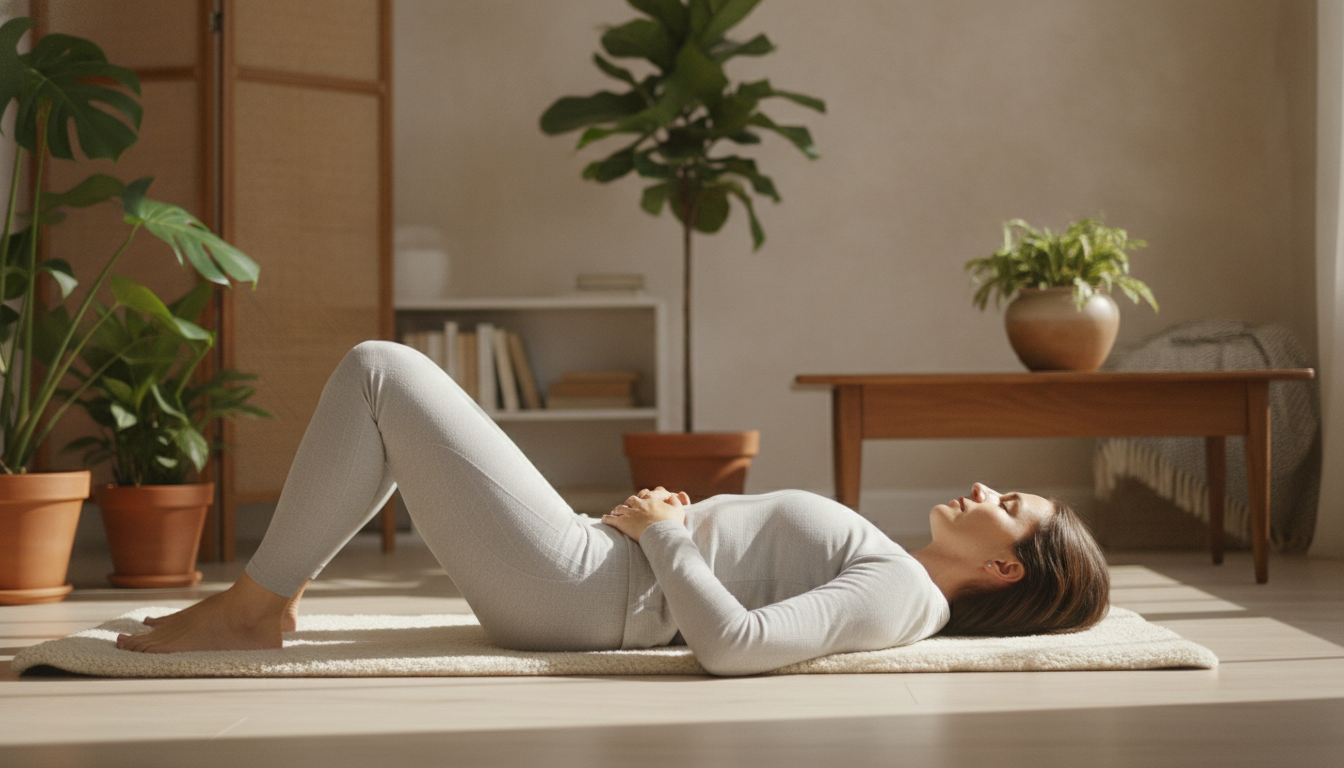
Forget complicated instructions with 47 steps. Here's how I actually do it and how you can start strengthening your body awareness through meditation today. No app needed, no expensive equipment, just you and 15 minutes of time.
Lie flat on your back, arms relaxed beside your body, palms up. I use a thin yoga mat, but carpet or a bed works just as well. Close your eyes and take three deep breaths in and out. Then you start at the feet: consciously feel into your left big toe. Don't move, don't tense, just feel. What do you notice? Warmth? Tingling? Pressure? Nothing at all? Everything is okay.
Move systematically through your body: from the toes through the soles, heels, ankles, calves, knees, and thighs to the pelvis. Then from the belly through the chest, back, and shoulders to the arms, all the way to your fingertips. Finally the neck, face, and head. The whole pass takes me about 20 minutes. In the beginning I started with 10 minutes and moved through the regions faster.
- Set a fixed time, not "sometime." For me it's 6:45 a.m., because I drink my first coffee at 7:00 a.m.
- Set a timer so you're not constantly looking at the clock. I use my phone's standard timer app with a gentle bell sound.
- Begin with 10 minutes and work up to 20-30 minutes when you feel like diving deeper.
- Find a place where you won't be disturbed for 15 minutes. I made it clear to my roommate that between 6:45 and 7:05 a.m. is my me-time.
- Use a guided meditation at first. I started with the free body scan guide from 7Mind, a German meditation app; after 4 weeks I no longer needed guidance.
How I learned mindfulness through the body scan
After about 3 weeks of daily practice, something strange happened: I was sitting in a café in Williamsburg, on Bedford Avenue, when I suddenly noticed that I had my shoulders hunched up. Just like that, in the middle of a conversation. In the past I would only have noticed it in the evening from my neck pain. Now I could sense it in real time and let go. That was the moment I understood: body scan meditation doesn't only work during the exercise, it changes your body awareness in everyday life.
Self-awareness meditation brings a carryover effect I hadn't expected. Today I notice not only physical signals sooner, but emotional ones, too. When something annoys me, I feel it first in my stomach as tightness before my head registers it. That gives me a head start of about 2-3 seconds in which I can decide how I want to react. Sounds like little, but it makes a huge difference.
Especially in stressful situations that used to throw my system completely off, this helps me enormously today. Similar to breathing techniques for inner calm, which I practice alongside it, the body scan gives me a tool I can use to regulate myself. I'm no longer at the mercy of stress; I've learned to read the warning signals.
Practicing body scan meditation daily: my reality after 6 months
Today, after half a year of consistent practice, I can honestly say: I haven't skipped a single day. Not because I'm superhuman, but because I noticed how much I miss it when I don't do it. On days when I wanted to skip it because of time pressure, I was more restless, more irritable, less centered. After 3 days without a body scan, I feel like someone who can't find their glasses: everything is somehow blurry.
My routine today: 20 minutes every morning, without guided instructions. I lie on my yoga mat in the bedroom, my phone is on airplane mode, the timer is running. Sometimes I also practice a shorter 10-minute version in the evening when I notice I'm still carrying the day inside me. That helps me sleep better and not go to bed with racing thoughts.
The physical changes are measurable: my chronic neck pain, which had been with me since my office days, is 80 percent gone. Not because the body scan is a miracle cure, but because I now feel when I'm building up tension and can counteract it. I recognize sooner when I need breaks, when I should drink water, when I'm overdoing it. That has improved my quality of life more than all my physical therapy appointments put together.
What body scan meditation has done for my life
The biggest change wasn't physical but mental. Through body scan meditation I learned to stay with myself. I used to be constantly in my head, planning, analyzing, comparing. Today I can bring myself back into my body when my mind is spinning out. That may sound mundane, but for someone who had just been functioning for years, it was revolutionary.
This ability to feel and regulate myself has helped me in other areas, too. On dates, in conversations, in difficult situations: I'm more present because I'm with myself. I can better judge what I want and what I don't, because I can read the physical signals. When something doesn't feel right, I now feel it as tightness in my chest or unrest in my stomach, instead of only analyzing it rationally.
According to a 2023 survey by the Max Planck Institute for Human Cognitive and Brain Sciences in Germany, 73 percent of regular meditators report improved emotional regulation and stress resilience. I can confirm those numbers from my own experience. Today I react much more calmly in situations that would have thrown me off track in the past. Not because I'm pulling myself together, but because I recognize the warning signals earlier and can regulate them.
Frequently asked questions about body scan meditation
How long does it take for body scan meditation to work?
For me it took about 2-3 weeks until I noticed the first changes. The truly noticeable effects on my body awareness came after about 6 weeks of daily practice. Studies show that neurological changes are detectable after 8 weeks of regular meditation. What matters: practice daily, even if it's only 10 minutes.
Can I do body scan meditation in bed?
Yes, but with a catch: you might fall asleep. I practiced in bed in the evenings at first and fell asleep 8 times out of 10. That's not bad for your sleep, but you miss the practice effect. Better: in the morning or at midday on a mat or on the sofa. If you want to practice specifically to fall asleep, bed is fine.
What do I do if I keep falling asleep during the exercise?
Change the time of day. I switched from evening to morning and the problem was solved immediately. Alternatively: sit up instead of lying down, which keeps you more awake. Or practice after a coffee instead of right after waking up. If you fall asleep anyway, that's a sign your body needs sleep, not meditation.
Do I need a guided meditation or can I do the body scan on my own?
I recommend a guided session for the first 2-4 weeks. It helps you learn the sequence and not rush through. I started with the 7Mind app, which has free body scan guides between 10 and 30 minutes long. After a month I noticed that I had internalized the structure and no longer needed guidance. Today I practice completely without.
How does the body scan differ from progressive muscle relaxation?
Progressive muscle relaxation works with actively tensing and relaxing the muscles. You deliberately tense muscle groups and then let go. Body scan meditation is purely observational: you don't tense anything, you don't actively relax, you just notice what is. The effect is similar, but the path is fundamentally different. Personally I find the body scan more sustainable, because you train mindfulness, not just relaxation.
My conclusion: why you should try body scan meditation
I won't claim that body scan meditation will change your life overnight. For me it took 6 weeks to feel real changes. But when I look back at what this simple technique has done in my life, I'd say: it was the best daily habit I've ever established. More important than journaling, more important than exercise, more important than any morning routine.
The ability to feel your own body again is worth its weight in gold in a world that constantly distracts you from yourself. Through it I've not only gotten my tension under control but also learned to listen to my needs. When do I need a break? When am I overdoing it? When does something feel right or wrong? I can answer these questions today because I read the answers in my body.
If, like me, you've spent years just functioning without really being with yourself, give it a try. 10 minutes every morning, for 2 weeks. That's all you need to find out whether it works for you. And if, like me, you discover that your body has been sending you signals for years that you've ignored, you'll understand why I call body scan meditation revolutionary. It's no exaggeration. It's simply true.